
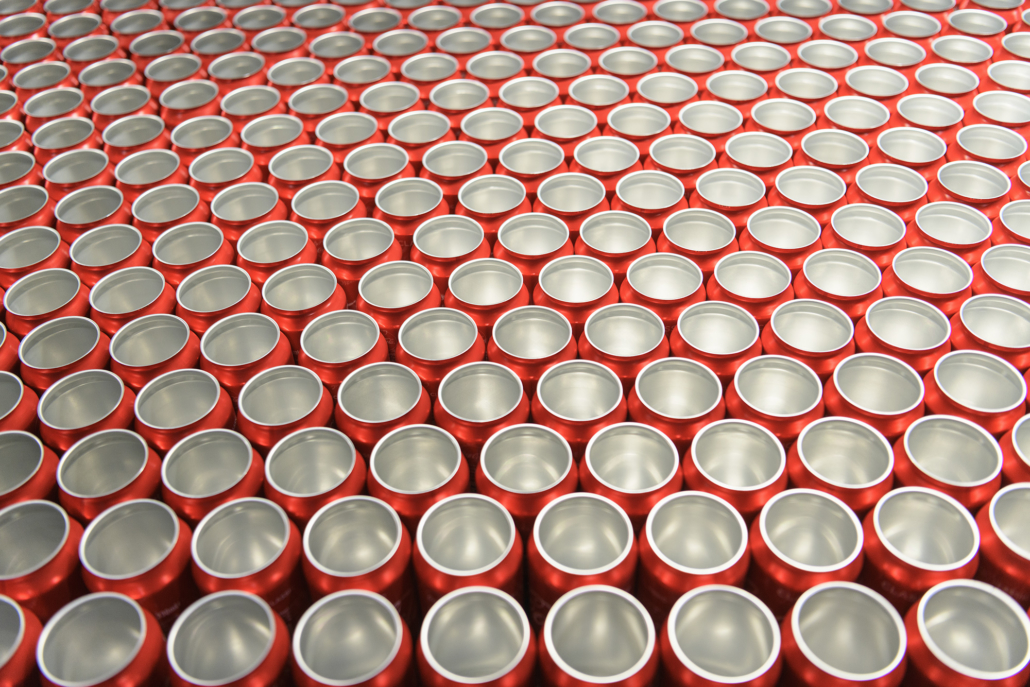
New Life Cycle Assessment of aluminium beverage cans shows significant carbon emissions reduction
PRESS RELEASE
Courtesy of Metal Packaging Europe
Brussels, 22 May 2019
Metal Packaging Europe, the association of European producers of rigid metal packaging and their supply chain partners, completed a new Life Cycle Assessment (LCA) of aluminium beverage cans (25, 33 and 50 cl volumes).
Using the latest data available (2016), the study covers the life cycle of aluminium beverage cans produced in Europe, from raw materials extraction to manufacturing, and end-of-life. When compared to 2006 data, the study records significant reductions in CO2-equivalent emissions. The carbon footprint has been reduced by an impressive 31% on average for the three volumes, confirming the industry’s commitment to reduce carbon emissions and to decouple production growth from its environmental footprint.
The main factors which have made this progress possible are:
- the continuous improvements taking place in the aluminium production and can manufacturing processes;
- a reduction in can weight; as well as
- an increase in aluminium beverage can recycling rate.
For a 33 cl can, the reduction on Climate Change impact over the 10-year period (2006 – 2016) is 33% and includes the following key figures:
- a 12% reduction in the aluminium ingot supply;
- a 35% reduction in electricity and heat consumption, thanks to improved efficiency of can making process, as well as a 4% reduction in body can weight;
- close to 50% increase in the aluminium beverage can recycling rate across Europe, going from 50% to 73% in 2014.
The 2016 data shows that, in terms of Climate Change impact, the average contribution of the cans manufacturing is 18% over the life cycle. Recyclability of aluminium remains the key factor for further improvements: for every 5% increase of recycled aluminium beverage can, an average of -6% reduction on Climate Change impact is achievable.
Aluminium beverage cans are a mono-material packaging, which make them easy to collect, sort and recycle. In 2015, the aluminium beverage can recycle rate has further increased to 74%, thanks to well-performing collection and sorting schemes and the active participation of consumers. Aluminium is a permanent material that can be recycled again and again, without losing its material characteristics, and its scrap value is the highest of all packaging materials, making aluminium beverage cans a perfect fit for the Circular Economy.
“It is part of Metal Packaging Europe’s commitment to provide fact-based and unambiguous information on our industry. We are pleased with the significant progress made by our members and are confident that even higher reductions will be achieved thanks to improved recycling rates across Europe,” said Leonie Knox-Peebles, CEO of Metal Packaging Europe.
The following Metal Packaging Europe members submitted data for 2016: Ardagh Group, CROWN Packaging Europe, Ball Packaging. European Aluminium provided the latest data sets for aluminium sheet production. Participating companies cover up to 87% of the relevant European markets.
The study, conducted by RDC Environment and reviewed by Solinnen, is fully compliant with ISO 14040/14044 standards.
For further information about Metal Packaging Europe:
+32 2 897 04 90
info@metalpackagingeurope.org
www.metalpackagingeurope.org
About Metal Packaging Europe:
Metal Packaging Europe gives Europe’s rigid metal packaging industry a unified voice, by bringing together manufacturers, suppliers, and national associations. We proactively position and support the positive attributes and image of metal packaging through joint marketing, environmental and technical initiatives. We represent the industry’s views and voice opinions so that stakeholders understand how metal packaging contributes to the Circular Economy.
About Metal Packaging:
Metal packaging is used throughout the retail, wholesale, commercial and industrial sectors. It comes in many shapes and sizes and can be used to package virtually any product. Some 98bn units are produced every year for the beverage, food, health & beauty, household and industrial markets. Made from permanent materials, metal packaging saves resources and continues to achieve record recycling rates in Europe, with a growing number of countries reaching in excess of 80%.



Got a question or comment?
Contact Us